Sunday, September 13, 2026


Fighting the Oligarchy’s Stranglehold on the Media

When it comes to media, journalism, and the broader information landscape, there’s a strong practical need to be utopian right now—to give us hope but to also provide clarity as to what we should be fighting for.

The Trump 2.0 era has intensified a deeply entrenched pathology in the American media system: concentrated corporate ownership. During less perilous times, legitimate concerns about a few corporations capturing so much of our news and information have often been dismissed as conspiracy theories and paranoia. But

Constant controversies—from government and corporate censorship of television comedians like Jimmy Kimmel and Stephen Colbert to the algorithmic and editorial abuses of Elon Musk’s X and Jeff Bezos’s Washington Post—remind us why media ownership holds such high stakes for any semblance of democracy. Meanwhile, rightwing nepotistic dynasties like the Murdochs and the Ellisons hold inordinate influence over what millions of people can see, hear, and read in their daily media.

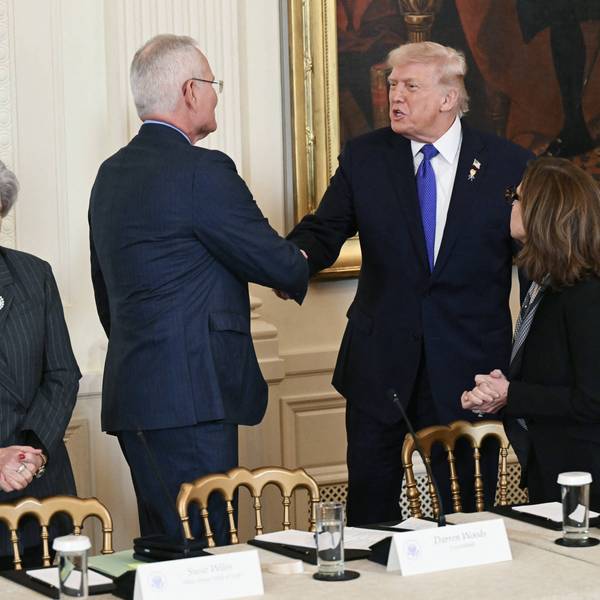
Our current media system is simply incompatible with democracy, making structural media reform an urgent priority. This includes unwinding previously approved and pending mergers—exhibit A being Paramount Skydance’s potential acquisition of Warner Bros. Discovery (which owns CNN and HBO, among other key holdings)—as well as trust-busting corporate media behemoths by forcing them to divest major components of their sprawling conglomerates.

Undoing the wreckage will take time, but we must lay the groundwork now to launch necessary structural reforms the moment we dethrone Trump and his ilk. This project requires a clear analytical framework for understanding exactly why such run-amok media concentration is bad for democracy, and why breaking up media conglomerates is both necessary and insufficient for reconstructing the media we need from the ground up.

Big corporate media mergers are bad for everyone other than those few who stand to profit. They’re harmful for media workers, consumers, local communities, First Amendment freedoms, and democracy writ large. Over the years, the dangers for democracy posed by media concentration have been borne out by empirical evidence. Research shows that media conglomeration can lead to less local news, more advertising, and shifts toward conservative political commentary, especially under the ownership of rightwing companies such as Sinclair.

According to basic democratic theory, ensuring diverse voices, viewpoints, and stories in our media requires a pluralistic range of media owners. However, the hypercommercialized, corporate-dominated US media system wasn’t devised to privilege democracy. In fact, given its weak public media system, oligopolistic media markets, and light public interest regulations—many of which eroded over time or simply were ignored (or weaponized under Trump)—the US media system is almost perfectly designed to not serve democracy.

Within this hypercommercialized media structure, despite many individual journalists’ courageous work to the contrary, profit imperatives too often trump democracy (bad pun intended). Capitalist logics undercut and skew democratic discourse by encouraging clickbait, excluding low-income communities, and degrading the quality of journalism. Capitalist incentive structures also lead to pronounced deficits through sheer cost cutting, and by treating news and information as commodities, not public services, and audiences as passive consumers, not engaged citizens.

Even during the best of times, media corporations often maximize profits by ruthlessly cutting corners and forcing their media workers to do more for less. Too often, costly services like high-quality journalism are dismantled while content that’s cheaply produced and easily replicated—like shouting heads across ubiquitous screens, endlessly capturing our attention for advertisers—gets amplified.

Media conglomeration only intensifies these commercial logics. For example, cost cutting typically accelerates immediately following big mergers when companies take on tremendous debt. New corporate ownership has subjected CBS to such restructuring and would likely do the same to CNN if the pending merger goes through, for which Paramount Skydance is reportedly incurring $79 billion in debt. To compensate, media corporations often combine newsrooms and lay off reporters—or eliminate journalism altogether in favor of opinion and commentary.

In addition to decimating jobs, managing such debt tends to result in outsourcing costs to audiences by raising prices, offering lower-quality programming, and providing less creative cultural fare. This outcome is especially detrimental given a media landscape already riddled with news deserts, in which scarce original journalism and local media content are being produced.

The debasement of our news and entertainment media is bad enough. But media conglomeration also creates private tyrannies wherein oligarchs command broad swaths of our media. Driven by perverse incentives, these media barons wield dangerous control over public discourse, warping how important issues get framed and what stories get told.

Conferring such political economic power onto a small elite is itself a severe democratic threat. Whether through lobbying, campaign contributions, or preferential press coverage of politicians in exchange for regulatory favors, these media oligarchs almost always develop corrupt relationships with those in government, undercutting the press’s much-vaunted “watchdog function” of holding the powerful to account.

Moreover, media consolidation is a structural precondition for authoritarianism. We saw such patterns play out under Hungary’s former Prime Minister Viktor Orbán, who demonstrated how authoritarians needn’t control newsrooms by gunpoint. Rather, they can rely on chummy oligarchs to discipline the media for them, resulting in news feeds and media channels saturated with government-approved talking points and propagandistic narratives that brook little dissent toward those in power.

It shouldn’t surprise us that billionaires are likely to deploy their media assets to advance their class interests. This is especially prevalent in the United States, given devalued media properties and extreme concentrations of wealth. To provide one stark example: Jeff Bezos bought The Washington Post in 2013 for less than half of what he would later pay for his super yacht.

In the final analysis, such concentrated corporate ownership—whereby a tiny elite commands so much power over our media—is antithetical to democratic society. Even if today’s villainous oligarchs had the hearts of angels, it’s far too much power for any individual to wield over our news media. Just as every billionaire is a policy failure, every billionaire-owned media outlet is a profound threat to our democracy.

How did the United States fall under this media oligarchy? Many of our contemporary media failures trace back to specific policies and political decisions. One such inflection point occurred during the 1930s and 1940s, when policymakers established a privatized and highly commercialized broadcast media system tempered by relatively weak public interest protections. The latter included what became known as the Fairness Doctrine, which President Ronald Reagan’s Federal Communications Commission (FCC) jettisoned in 1987.

The United States belatedly established a chronically underfunded public broadcasting system in the late 1960s. But after a period of modest progressive policymaking, we began rolling back media ownership restrictions and “deregulating” our media in the 1980s, leading up to the infamous Telecommunications Act of 1996, when media consolidation began to escalate. In many ways, our oligopolistic media landscape has only worsened since the merger mania of the Clinton-Bush neoliberal heyday.

Particularly alarming is the utter collapse of local journalism, in which more than 40 percent of our newspapers and three-quarters of our local journalists have vanished since the early 2000s. Meanwhile, FCC Chair Brendan Carr is a loyal apparatchik for bullying what’s left of our independent media into capitulation to Trump.

Combined with the federal defunding of our public media, few structural alternatives and countervailing forces can withstand a blasted media landscape dominated by profit imperatives and a handful of media moguls. What’s to be done?

Today we face a dangerous new terrain upon which an authoritarian government weaponizes a hypercommercialized corporate media system against democracy. Yet, the market libertarianism and policy failures over the decades that enabled media oligarchy weren’t inevitable or natural, nor must they be permanent. These were political choices, and politics are subject to human agency and change. But first we must denaturalize this hypercapitalistic system that turns our media against democracy.

To begin, we must recognize that our media pathologies run even deeper than bad billionaire media owners doing bad things. Ownership structures are only part of the problem—a key part, to be sure—downstream from the core root of our media polycrisis: capitalism. Confronting media monopolies requires us to reckon with the underlying conditions that made such concentration possible, specifically the hypercapitalist logics capturing our information and communication infrastructures from root to branch.

Indeed, our media’s systemic problems predate the recent spate of mergers under Trump. While today we must stop mega media mergers, tomorrow we must create an entirely new public media ecosystem in service to local communities. To combat the capitalist capture of the entire American media apparatus that produces various kinds of “market censorship” that would-be autocrats like Trump can exploit, we must create a non-capitalistic system—a truly public and independent media system—that’s owned and controlled by us all.

Fortunately, recent positive signs have already emerged at the state and local levels, ranging from contesting media mergers by state attorneys general to making public investments toward local journalism. Yet we must broaden our political imagination and plan for bold national policy interventions for the post-Trump moment. There’s a strong practical need to be utopian right now—to give us hope but to also provide clarity as to what we should be fighting for. We need a long-term vision firmly planted on our political horizons—we can dare to imagine a media system that privileges democracy over power and profit. 


I am so damned sick and tired of this war on women. Stop blaming women because of men’s failures. Women stepped up to work in tobacco factories in the South during the war to keep the economy going. We learned espionage codes, took care of our wounded soldiers, piloted rickety bombers, and used our womanly wiles to get enemy secrets. Meanwhile back home we raised crops and gardens to feed ourselves and make profits during harvest. We kept the home fires burning and intact. We continued to have and raise children alone. Furthermore, we learned and did what we had to. When our country needed us, we rose to the occasion, and we did it well.
Now, under the Trump authoritarian regime of highly educated men who truthfully are unfit to work in a pie factory as tasters, we are going bankrupt. These so called scholarly men in Congress are nothing but cowards who have spit on our constitution for a convicted felon, and an adjudicated rapist. You men are despicable. When your country needed you, where were you? Writing stupid articles for your misogynist, heinous Heritage Foundation papers on how to blame women for your failures and how to have a society that caters to rich oligarch men. All the while destroying our country, and robbing the working class, the backbone of this country that made it great. You only see women as sex objects and birthing vessels to cater to and serve you like kings.
The only thing your mother and Trump's mother did wrong was they did not drown your ungrateful asses in the river after birth. You make me nauseous 🤮🤮🤮 Women are not your slaves. We are not going back to your puritan days. F~ck all of you misogynist🐷🐷VR
Cathy Martin
See less
 
OMG! This Heritage Foundation Sodomite is invoking the Telepathic, Unilateral, Preemptive, Irreversible, Declassification, (S.T.U.P.I.D.) DEFENSE! Ms. Cathy Martin's response burned his hut down; many thanks. 


Saturday, September 12, 2026


 They sold you scarcity like it was a law of nature.

Oil is “running out.”
Water is “running out.”
Land is “running out.”
Food is “running out.”

But look closer.

Oil reserves change as technology, exploration, economics, and extraction methods change. Water continuously cycles through the planet, yet access to clean freshwater remains uneven. Huge amounts of land exist, while ownership, infrastructure, climate, and policy determine how much can actually be used. And globally, enormous amounts of food are produced while millions still struggle to access it.

So maybe the deeper question isn’t simply:

“Do we have enough?”

Maybe it’s:

WHO CONTROLS THE ACCESS?

Because abundance means very little when the resources are concentrated, restricted, wasted, priced beyond reach, or controlled by institutions powerful enough to determine who gets what.

That’s where the conversation gets uncomfortable.

When something becomes scarce, or is perceived as scarce, its value rises.

Prices rise.
Dependence grows.
Competition increases.
And whoever controls the supply gains leverage.

That doesn’t prove every shortage is deliberately engineered. Droughts, geography, infrastructure, conflict, production costs, and real physical limits matter.

But artificial scarcity is real too.

Supply can be restricted.
Resources can be monopolized.
Food can be destroyed while people remain hungry.
Land can sit unused while housing becomes unaffordable.

THE RESOURCE AND YOUR ACCESS TO THE RESOURCE ARE TWO DIFFERENT THINGS.

That distinction changes the entire conversation.

Once you understand that, you stop automatically asking, “Why isn’t there enough?”

And you start asking:

Who owns it?
Who distributes it?
Who sets the price?
Who benefits from the shortage?
And who benefits when you believe scarcity is inevitable?

👁️ QUESTION THE SYSTEM, BUT FOLLOW THE EVIDENCE.

The Awakening Compass was made for people willing to question the narratives they inherited and explore a different perspective.

📕 Grab your copy through the link in our bio.

#ArtificialScarcity #ResourceControl #QuestionEverything #AwakeningCompass #RecommendedBooks
See less


California's about to make it stupid easy to slap a solar panel on your balcony and plug it straight into your wall. No utility company permission slip required. No months of bureaucratic theater. Just buy it, mount it, done.
The real problem was always the paperwork. Your utility wanted to run you through a full interconnection process designed for massive rooftop arrays—except you're just trying to power a fridge and some lights with a 300-watt panel. The cost in time and forms exceeded the cost of the actual equipment. It was absurd.
SB 868 cuts through that. Small systems get a fast track with actual safety built in—UL certification, automatic shutdown if the grid goes down (which keeps line workers from getting fried), and a 1,200-watt cap. This is how Germany's been doing it for years. Over a million balcony systems over there, sold at hardware stores like they're garden tools.
The catch? The exemption expires January 1, 2030 unless the legislature renews it. Four years to prove the market works. But here's why that matters: California is the solar market in this country. Manufacturers build for California. If it works here at scale, it spreads everywhere.
Ten states have already passed versions. New York's got the same bill waiting on the governor's desk right now. This isn't fringe stuff anymore—it's becoming the baseline for how renewable energy actually gets deployed in the real world.

Thursday, September 10, 2026


BREAKING: BIG BROTHER — Elon Musk’s voter registration site scandal exposes the CREEPY data exploitation machine behind the patriotic branding.
Elon Musk didn’t become the world’s richest man by ignoring opportunities. So, how could he pass up the chance to exploit you and your accompanying data into not just a profit center, but a propaganda tool to promote his fascistic worldview?
Elon Musk wants you to check your voter registration status by using a website that he built called votesafe.org. The less cynical among us may see that as an altruistic gesture that helps further democracy. But what Musk has actually done is build a data-mining operation disguised as civic engagement, and it's already being pushed to millions of Americans.
The federal government's real voter registration tool, vote.gov, collects virtually no personal information and doesn't track your activity. Musk's competing site, votesafe.org, run through his America PAC, does the exact opposite.
According to Popular Information's Judd Legum, the site harvests your full name, date of birth, home address, email, cell phone number, IP address, browser fingerprint, and even every single link and page you click while visiting.
And it gets worse.
On August 29th, votesafe.org quietly updated its privacy policy, stripping out previous language that limited how your data could be used. The new policy explicitly allows America PAC to "share" or "sell" your personal information, including your voter registration status and how you cast your ballot, to unnamed "business partners."
It can also sell "inferences" about your "psychological trends, predispositions, behavior, attitudes, intelligence, abilities, and aptitude" — essentially a psychological profile built from your browsing behavior, sold to whoever's buying.
As you use the site, your street address gets sent to Facebook and Google. Your contact information feeds directly into Facebook's ad-matching system. A scrambled version of your email gets sent to an ad-tracking firm that follows you across websites, apps, and streaming services. Your activity is shared with X, Musk's own social network, and yet another tracking company, Incrementdata. A device fingerprint is created so you can be tracked even after deleting cookies.
This isn't a rogue side project either. Musk has pledged over $100 million toward the midterms, with votesafe.org's data collection sitting at the center of that strategy. The platform is already being white-labeled by allied groups, including the Heritage Foundation's Sentinel Action Fund and an organization called Ready to Register, which North Carolina election officials say has mailed outdated registration forms, including some to deceased voters, using outdated data.
Voter registration should be simple, secure, and free from corporate surveillance. Instead, Musk has built a machine that turns your basic civic participation into a data goldmine, sold to the highest bidder, all wrapped in patriotic branding designed to look like it's helping you vote. Be forewarned!
Please like and share if you DON’T want to help make Elon Musk any richer!

Tuesday, September 8, 2026


🌕✨ TWO FULL MOONS IN THE AUTUMN SKY! ✨🌕
Get ready for a beautiful celestial spectacle! 🌌
In 2026, the September and October full moons bring two famous seasonal names:
🌾 September 26 — Harvest Moon
The Harvest Moon is the full moon closest to the autumnal equinox. Traditionally, its bright evening light helped farmers continue working after sunset during the harvest season.
🏹 October 26 — Hunter’s Moon
The following full moon is traditionally known as the Hunter’s Moon. Historically, its bright light was associated with preparing for winter and hunting after the harvest.
🌙 Why are they called “Harvest” and “Hunter’s” Moons?
These names come from traditional seasonal naming systems, particularly those associated with Indigenous and European traditions. The names can vary by culture and region.
✨ Fun fact:
A full moon occurs when the Moon is opposite the Sun as seen from Earth, allowing the side facing Earth to appear almost completely illuminated.
🔭 Look up!
If skies are clear around these dates, step outside after sunset and look toward the eastern horizon. The Moon can appear especially dramatic when it is low in the sky, surrounded by the colors of dusk.