I hear that. Unfortunately, my 2014 laptop got bricked by one of those incessant monthly Cumulative Quality Updates that Microsoft is damn fond of and it glitched so badly that it just goes through and endless loop of attempting to repair. And of course all of my medical and financial documents are stored on it and bit-level encrypted with nothing stored in the cloud as I don't trust any big tech companies with access to such data! But those bloody AI Data Centers have started to buy up ALL of RAM, CPUs, GPUs, HDDs and Nvme SSDs so that I can't get parts to build one and prebuilt are too expensive. 🤬 My hatred of these companies is beyond words to express adequately.
I don't wish to sound overly paranoid but Western Digital one of the largest Hard Disk Drive makers recently announced that they have halted ALL consumer sales of their drives for the rest of 2026 and don't currently intend to resume consumer sales until late 2028 or possibly 2029. Tell me that this isn't suspicious that big tech doesn't intend for the average consumer to be able to afford or even obtain a new computer until AFTER the presidential election in 2028? They want us to be restricted to Phones and Web-based services that they (Larry Ellison's Oracle and Thiel's Palantir) can control or at least significantly influence!
Yesterday 6:02 PM
Saturday, July 4, 2026
AI is shaping up to be the single largest misallocation of capital and energy in human history.
Trillions poured into data centers burning enough energy to power nations.
Draining enough water to empty rivers.
For what?
A slightly better cold email.
Celebrity deepfakes.
Customer support chatbots nobody wants to talk to anyway.
We’re burning the Physical World to pollute the Digital World.
And we’re supposed to believe the guy who begged to go to Epstein Island is going to save us?
I’m not falling for it.
AI is great for automating repetitive work.
But has anyone asked: “Why are we drowning in repetitive work in the first place?”
We’ve built lives filled with tasks humans were never designed to do.
Now we’re racing to create an unlivable world where robots do 100% of the work humans were never supposed to do in the first place.
They’ll tell you we’re automating toward freedom.
“A world where you can do whatever you want.”
Whatever we want?
There was once a fisherman sitting on a beach, lines in the water, enjoying the sun.
A businessman in a suit walked up and asked what he was doing.
“Fishing,” the fisherman said.
“How long will you fish today?”
“A few hours. Maybe catch enough for dinner.”
The businessman saw opportunity.
“Listen. If you fished all day, you could catch more. Sell the extra fish. Buy a second boat. Hire men to fish for you. In 20 years, you could sell the whole operation, retire rich, and spend your days relaxing on the beach.”
The fisherman looked at him.
“What do you think I’m doing right now?”
We’re building robots to give us back the life we already had before we built the system that stole it.
Law Firms Funneled Millions to Chief Justice John Roberts’ Wife. He Followed the Rules. That is the Scandal.
$10.3 Million, Zero Names: The Conservative Case for Fixing Judicial Ethics
—Alexander Muse
Suppose a citizen, curious about the finances of the most powerful judge in America, had pulled Chief Justice John Roberts’s annual disclosure form at any point between 2007 and 2014. Here is the sum of what she would have learned about his wife’s career. Jane Roberts was employed by Major, Lindsey & Africa, described as attorney search consultants, and her income was of the type called salary. Our citizen would form a perfectly reasonable picture from those words, a respectable professional job in legal recruiting, the sort that pays perhaps $150,000 or $250,000 a year. She would close the file and think no more about it.
The picture would be wrong by an order of magnitude. Over those 8 years Mrs. Roberts collected $10,323,842.70 in commissions on $13.3 million in revenue attributed to her, figures drawn from her own firm’s internal spreadsheets, and by one sworn account she was the highest earning recruiter at the entire company by a wide margin. Now, a distinction is useful here, the distinction between a statement being true and a statement being informative. The form was true. The form was also, for any purpose the public might care about, empty. A disclosure regime under which an eight figure commission practice and a modest salaried job generate identical filings is not a disclosure regime in anything but name. That gap, between what the form says and what the money is doing, is the entire subject of this essay.
Let me say plainly what I am not arguing, because the argument fails if the reader mistakes it. I am not claiming the money was illegitimate. Recruiters who reviewed the figures for Business Insider called them plausible for someone with her network, and no wrongdoing by the Chief Justice or his wife has been established by anyone. Nor am I claiming Roberts violated any rule. So far as the record shows, he complied with every requirement the law placed on him. That concession is not a courtesy I extend before the real attack begins. The concession is the argument. A careful, honest, compliant man followed every rule, and the public learned essentially nothing. Whatever else that proves, it proves the rules cannot be doing their job.
Begin with who was actually paying. Legal recruiters are compensated by the law firms that hire their candidates, so the commissions originated with those firms and merely passed through Major Lindsey on their way to the Roberts household. The disclosure forms named only the employer, never the client firms writing the checks. We know the identity of exactly 4 placements, and only because they surfaced in litigation documents. Ken Salazar went to WilmerHale, Robert Bennett to Hogan Lovells, Neil MacBride to Davis Polk, and Michael Held to WilmerHale. WilmerHale and Hogan Lovells are among the heaviest repeat players before the Supreme Court, the firms whose partners argue there season after season. The full client list has never been made public, and under current law it never has to be.
Consider next how we came to know even that much, because the provenance of these facts is itself a lesson. In 2013 Major Lindsey fired a recruiter named Kendal Price. He sued the firm and Jane Roberts over his dismissal, and he lost. Nearly a decade later, in December 2022, he sent the litigation record, including Mrs. Roberts’s 2015 sworn testimony and the internal commission spreadsheets, to Congress and the Department of Justice. A skeptical reader will object that Price is a disgruntled former colleague with a failed lawsuit, and the skeptical reader is correct. But notice what follows from that objection. The only window the American public has ever had into the finances of the Chief Justice’s household is discovery material from somebody else’s employment dispute. Transparency by litigation accident is not transparency. If the disclosure system were functioning, Price would have had nothing to reveal, because the essentials would already have been on the forms.
There is also an admission in this story that nobody had to sue for. Mark Jungers, a former Major Lindsey managing partner, told Politico that the firm hired Mrs. Roberts because it hoped to benefit from her being married to the Chief Justice, observing that her network was his network and vice versa. He later assured Business Insider that he never saw her use the connection inappropriately, and of course he did. He is a recruiting executive protecting the industry’s most famous hire, and his denial is precisely what a denial would sound like whether or not it were true. The admission that matters is the first one. The market priced her marriage. Sophisticated law firms understood that hiring through the Chief Justice’s wife purchased something, and whether that something was influence or merely the appearance of access is beside the point, because federal ethics rules exist precisely to police the appearance. They captured none of it.
The pattern did not end in 2014. In 2019 Mrs. Roberts moved to the recruiting firm Macrae as a partner and acquired an ownership stake the value of which has never been disclosed. That stake appeared on none of the Chief Justice’s filings for 2019, 2020, or 2021. It surfaced on his 2022 report, filed in mid 2023, months after Price’s complaint reached Congress and weeks after the documents were published, accompanied by an explanation of inadvertence and amendments to the prior 3 years. I am content to take the Chief Justice entirely at his word about the inadvertence. Again, the disclosure rules do not require the justice to disclose the value of the equity stake. Two observations survive the concession. First, the correction followed exposure rather than internal review, and readers may weigh that sequence for themselves. Second, and more important, nothing would have happened either way. The civil penalty for false filings under 5 USC 13106 applies only to knowing and willful falsification, it requires the Judicial Conference to refer a judge to the Attorney General, and that referral mechanism has never once been invoked against a Supreme Court justice. In practice an amendment cures everything and nobody is ever penalized. A rule that has never been enforced against anyone in its class is not a rule. It is a suggestion wearing the costume of one.
Now assemble the pieces, because the force of the argument lies in the conjunction. The Ethics in Government Act requires a justice to disclose only the source, type, and dates of a spouse’s income, never the amount, so $10.3 million and $150,000 produce the same line on the same form. The client firms paying the commissions do not count as sources under the rules, only the employer does, so litigants before the Court may route seven figure payments into a justice’s household with no paper trail visible to the public. Mrs. Roberts’s earnings since 2014 are wholly unknown, she remains a Macrae partner today, and the payments have presumably continued for another decade about which we know literally nothing. The Judicial Conference’s Advisory Opinion 107, issued in 2009, blesses non recusal where a spouse recruits for firms appearing before the judge, and Roberts has apparently never recused himself because of his wife’s work. The Code of Conduct the Court adopted in November 2023 created no body to receive a complaint, conduct an investigation, or impose a sanction. Every sentence in this paragraph describes lawful conduct. Read together, they describe a machine for undetectable influence, and the hinge of the matter is materiality. A few hundred thousand dollars of spousal income is background noise that no serious person thinks could move a justice. Millions of dollars flowing from repeat Supreme Court litigants is material by any standard we apply to anyone else, to any lower court judge, any corporate director, any federal contractor. The Supreme Court is the one place in American public life where that distinction has been rendered invisible by design.
Conservatives should be the ones to repair this, and for reasons that are conservative to the core. The right spent 50 years building this Court, patiently, through the Federalist Society’s long argument for originalism and through institutions like the Heritage Foundation that defended judicial independence against court packing schemes and jurisdiction stripping fads. That Court’s authority is our inheritance to protect, and an unguarded gap in its ethics architecture is an invitation to people whose ambitions run well past reform. The fixes are modest and none of them touches judicial independence. Congress should require dollar ranges for spousal earned income, exactly as filers already report ranges for investments. It should require disclosure of any client whose payments to a justice’s spouse exceed some threshold, perhaps $50,000 in a year, whenever that client is a party or counsel before the Court. It should require automatic docket disclosure, not recusal, merely disclosure, in any case argued by a firm that paid the justice’s household above a materiality threshold in the prior 5 years. And it should give the ethics code an enforcement home, even one internal to the judiciary, so that a claim of inadvertence is reviewed by someone other than the man who signed the form. Disclosure rather than disqualification remains the default remedy throughout, and sunlight is the conservative answer to the left’s packing plans and disbarment stunts.
John Roberts has done almost nothing wrong, and that is the problem. The rules let the money in, kept the names out, kept the amounts secret, and asked nothing when the forms proved incomplete. A system that a careful man can satisfy while the public learns nothing is not an ethics regime. It
The
kaleidoscope was invented in 1816 by a Scottish scientist, Sir David
Brewster. Looking through his invention, Brewster saw, at the end of the
tube, shards of colored glass reflected in mirrors to create
symmetrical patterns that changed as the tube was rotated, producing
endless transformations. He soon realized that, viewed through the tube,
anything could become kaleidoscopic: “The furniture of a room, books
and papers lying on a table, pictures on the wall, a blazing fire, the
moving branches and foliage of trees and shrubs, bunches of flowers,
horses and cattle in a park, carriages in motion, the currents of a
river, waterfalls, moving insects, the sun shining through clouds or
trees.”
When
Brewster’s device reached the market, the public was captivated. It
seemed to magically transmute the physical world into a cascade of
patterns for private viewing. But its influence eventually became
figurative, too: The kaleidoscope offered a new way of seeing —
one that could be extended to cultures, societies, and even nations as a
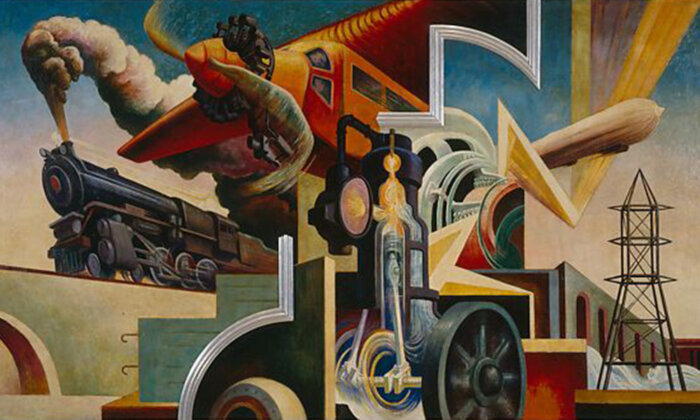
whole. And by the following century, the kaleidoscopic lens had turned
toward an America in great flux.
Between 1876 and 1929, Americans
experienced an unprecedented increase in energy. The census found that
adopting oil, gas, and electricity increased agricultural power by 800
percent and industrial power by 600 percent. The urban population
mushroomed from 10 to 69 million, and factory productivity increased
almost 200 percent. By 1929, every job was far different from what it
had been in 1876, whether it be plowing, mining, forging steel, making
cement, constructing an office building, assembling a product, or
running a company. During the transition, Americans witnessed remarkable
feats of engineering. There were suddenly skyscrapers, hydroelectric
dams, irrigation systems, department stores, and suburbs; this was,
after all, the era of the Chrysler Building, the Model T, and the Golden
Gate Bridge. Meanwhile, technologies like the telephone, radio, and
film accelerated mass communication.
Yet at the time, Americans
did not understand that they were living through the largest energy
transition in human history. Instead, they perceived a series of
disconnected events. Unable to discern or conceptualize an underlying
cause, they often declared the transformations around them were
“kaleidoscopic.” In fact, the use of this metaphor doubled in the 1870s
and quadrupled between 1900 and 1920 to describe a changing society and
to celebrate a limited range of social and ethnic differences while
touting technological progress and urban multiplicity.
It seemed a world of cause and effect with no losses.
As one journalist reported in Harper’s New Monthly Magazine,
Pittsburgh’s mills, rivers, bridges, illuminations, and amusements were
“a great kaleidoscope, showing new attractions at every turn.” Other
guidebooks praised Chicago, St. Louis, Washington, D.C., and New York in
similar terms, with one describing Broadway as “an ocean-tide of travel
and traffic, and the eye can find food for continual interest in its
changing kaleidoscope.”
Railroads framed the passing scenery with
plate glass windows. Bicycles expanded the range of daily movement.
Streetcars were faster and slightly detached from the passing scene,
which became an unwinding panorama. Motorists, encased in steel and
partially deafened by engine noise, accepted sensory remoteness in
exchange for acceleration, speed, and control. Meanwhile, for amusement,
people threw themselves into the gyrations of the Charleston and other
fast-paced dances, moving to 200 or even 250 beats per minute. They
sought out the disorienting sensations of Ferris wheels, rollercoasters,
carousels, elaborately lighted dance halls, swirling electric
fountains, and spectacular fireworks. The painter Joseph Stella depicted
the symphony — or cacophony — in his “Battle of Lights, Coney Island,
Mardi Gras” (1913–1914), explaining like so:
“I built the most intense arabesque that I could imagine in order to convey in an [sic]
hectic mood the surging crowd and the revolving machines generating for
the first time not anguish and pain but violent pleasures.”
Americans
saw their history as a story of unfolding progress, and the energy
transition seemed not a disruption but rather an accelerated
continuation. It seemed a world of cause and effect with no losses.
But
losses there were. While America’s kaleidoscopic metaphor captured the
beauty and propulsive force of the country’s energy revolution, it
obscured its dark consequences. In the kaleidoscopic viewfinder, there
was no hierarchy, no center, no dominant or subservient parts, and no
explicit narrative other than the assumption of progress. Further, there
seemed to be no exploitation of labor or resources, no class tensions,
and no entropic losses. The disquieting instabilities of unemployment,
industrial mergers, and frantic urban growth went unnoticed.
The
metaphor, for example, was used to describe the new Yosemite or
Yellowstone national parks in all their natural splendor. But it left
little room for the destruction of the buffalo herds on the western
plains, or the extinction of the passenger pigeons that once appeared by
the millions, in clouds stretching from horizon to horizon.
The
metaphor was used in reference to America’s industrial might. But it was
not used to describe the brutal realities of the 1911 Triangle
Shirtwaist Factory Fire, where 146 men, women, and children perished
because the fire doors were locked, or the Avondale Fire in a
Pennsylvania mine that killed over 100 workers who had no chance of
escape because the blaze broke out near the only exit.
Railroads
carried the same contradiction. They may have advertised the
“kaleidoscopic views” along their lines, but they seldom mentioned the
hollowed-out wastelands surrounding the mines that supplied iron, lead,
nickel, and copper on which those lines depended. By the 1890s, the
railroads served countless mining districts, where smelting operations
released tons of arsenic into the atmosphere every day. In particular,
they served the lead and zinc mines in Picher, Oklahoma, where dusty and
poorly ventilated shafts and reduction mills created towering piles of
toxic tailings. Though lead constituted less than 10 percent of the ore,
the tailings contained cadmium and other chemicals that polluted the
underlying aquifer. When the ore ran out, sinkholes opened, tunnels
collapsed, and Picher became — and still remains — a ghost town.
Women, immigrants, sexual minorities, and the impoverished were
excluded from the “kaleidoscopic” freedoms that progress was supposed to
bring.
This destruction of the natural
world underwrote some of the era’s most ambitious engineering and urban
projects — such as the Boston Back Bay, the reversal of the Chicago
River, Seattle’s Denny Regrade, New Orleans’s wetland drainage, New York
City’s Jamaica Bay, and San Francisco’s Mission Bay. Growing cities
seized distant rural valleys for water supplies and forced the
evacuation of entire towns. Sprawling factories spread into the
hinterland, polluting waterways, flattening hills, driving away or even
exterminating native species, as they reshaped the land.
Even
James Truslow Adams, the historian who gave the “American Dream” its
name — which cast the U.S. as a land of economic and social opportunity —
condemned this rampage of development. “It was not a question of
preparing a continent for habitation,” he proclaimed in 1929.
“It was one of money-maddened men furiously wrenching wealth from it in
every way their ingenuity and greed could devise, from the land, from
the forests above it, from the mines below it.”
In
1895, the Atlanta Exposition invited the African American theologian
and orator John Wesley Edward Bowen Sr. to speak on “Negro Day” about
his vision of rapidly changing America. His very presence was a gesture
toward racial harmony, and if one reads his address as a whole, it is
very much an effort to promote the abilities and the promise of Black
American labor in the New South. Like many of Bowen’s white
contemporaries, he drew on the kaleidoscope as a metaphor. The
transformations of modern life, he said,
passed before the eye “like dissolving and charming lines in the
kaleidoscope,” leaving the mind overwhelmed. The “New Negro,” he argued,
longed for the chance to take his place “in the ranks of one common
humanity.”
But Bowen’s hopes for the future of racial harmony proved too optimistic.
While
kaleidoscopic America celebrated the varieties of white, middle-class
European immigrants, the same could not be said for other racial
minorities. In fact, after Reconstruction, even as the metaphor became
more popular, segregation increased, and in the 1890s, the Supreme Court
cemented its legitimacy: All facets of African American life were
circumscribed by Jim Crow laws. Denied meaningful social or economic
mobility, many Black Americans were confined to the most grueling and
poorly paid forms of labor — shoveling coal, washing and ironing
clothes, digging ditches, and cleaning homes and streets — doing the
work that kept the modern city running while being excluded from its
rewards.
Meanwhile, a specter of violence, owing in part to a
resurgent Ku Klux Klan, was also present. Indeed, the kaleidoscopic
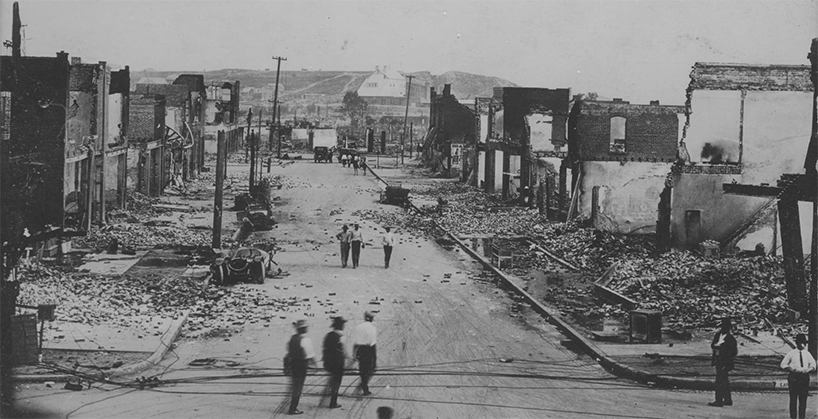
metaphor was ill-suited to describe the riot that burned down the
Greenwood neighborhood in Tulsa in 1921, leaving thousands of Black
people homeless, or to describe the 3,224 lynchings that the NAACP documented between 1889 and 1919.
Charred
homes and businesses in Tulsa’s Greenwood District after the 1921
massacre, when a white mob attacked and burned the prosperous Black
neighborhood known as Black Wall Street. Courtesy of the Tulsa Historical Society and Museum.
Meanwhile,
women, Asian, Jewish, and Hispanic immigrants, sexual minorities, the
unhoused, and impoverished sharecroppers were likewise excluded from the
“kaleidoscopic” freedoms that progress was supposed to bring. In
particular, Native Americans — who were expelled from their homelands to
create national parks, which were later celebrated as if they had been
established on vacant land — struggled to preserve their cultures
against continual pressure to assimilate.
Yet, in the
kaleidoscopic imaginary, all Americans were like the young white man
that John Dos Passos described in the opening pages of his trilogy
“U.S.A.” They had walked fast through the streets, eager to take up all
the jobs and see all the sights. Their muscles stretched toward a
cornucopia of jobs, laying down the new asphalt roads, fishing from
trawlers on Lake Superior or off the Maine coast, riveting the steel
frames of skyscrapers, driving the new interurban cars from Muncie to
Indianapolis, building bungalows in the orange groves outside Los
Angeles, selling electric irons and toasters to Philadelphia housewives,
drilling for Texas oil, excavating the Panama Canal, making a
precisionist painting, or writing a modernist novel about Chicago. It
was a white man’s world of hopeful struggle.
But America was not
an all-white nation, and not everyone could share equally in its promise
of hope — not the women excluded from many professions, not the Black
Americans living under segregation, not the Native Americans stranded on
reservations. The kaleidoscopic metaphor pandered to an individualistic
dream of success that even many white men would never realize:
Mechanization made many redundant. More miners died of silicosis than
struck it rich. Some workers suffocated in a grain silo, were
electrocuted by touching a live cable, or lost a hand in a machine.
Despite the prosperity, workers were restless, and in 1912, annual
turnover in meat-packing plants, machine shops, textile mills, and
automobile factories averaged an astonishing 115 percent.
At the
end of “The Big Money,” the third volume of “U.S.A.,” Dos Passos’s young
protagonist had no job, no family, and no home. While hitchhiking west,
he wears a threadbare suit and broken shoes, but none of the passing
cars offer him a ride. When he was young, the opportunities of America’s
transition seemed limitless. But with the Great Depression, the
blinders came off. Individualism was not sufficient, industrial progress
was neither assured nor automatic, and the nation’s kaleidoscopic
beauty was revealed as an optical (or rhetorical) illusion. The metaphor
had not resolved America’s contradictions; it had only rearranged them
into pleasing forms.
David E. Nye is
an American historian specializing in the history of technology. His
thirteen books with the MIT Press include, most recently, “The Great Energy Transition: America from 1876 to 1929.”
His work has been recognized by the Leonardo da Vinci Medal in 2005 and
a knighthood conferred by the Queen of Denmark in 2013.
Thursday, July 2, 2026
Drought has pushed the Rio Grande river past the breaking point – in Albuquerque, it has completely dried up.
For the third consecutive year, a combination of record-low winter snowpacks, warming spring temperatures, and persistent drought has left the Rio Grande completely dry through Albuquerque. This ecological crisis has arrived earlier and stretched further north than in previous years, leaving the river's fragile ecosystem in jeopardy.
Reservoirs across New Mexico are hovering at near-empty levels—with Elephant Butte currently at just 9% capacity—forcing water managers to triage scarce resources.
Despite efforts by federal agencies to artificially trigger fish spawning, the endangered silvery minnow is suffering a catastrophic decline, with countless fish left stranded on the parched riverbed.
The crisis highlights a looming reckoning for the American West, where states spend roughly 75% of the year in some level of drought. While Albuquerque's municipal water supply remains secure due to redundant groundwater systems, the drying river serves as a severe warning about long-term climate shifts. Compliance with the strict 1938 Rio Grande Compact prevents simple water reallocations, leaving local authorities to desperately hope for strong monsoon rains. Ultimately, experts urge that this dry spell must serve as a catalyst for aggressive public water conservation, particularly regarding outdoor irrigation, as emerging demands like technology infrastructure place even greater pressure on already depleted water systems.
source: Mencinger, A. (2026). Bone-dry bosque: Rio Grande stops flowing in Albuquerque. Santa Fe New Mexican.
See less
FROM RABBI ANDRUE KAHN, of NYC, Executive Director for the American Council for Judaism:
"I’m noticing that many people upset about the way AIPAC is being framed, and particularly about the way Mayor Mamdani described it, don’t seem to know the facts about AIPACs tactics over the past couple election cycles.
At last public count, this cycle AIPAC's super PAC has spent more than $38 million, on track to pass the $46 million it spent in 2024.
The dark money, a term of art for the tactic AIPAC is using, can only be fully counted after the elections are over.
Because AIPAC's own name has become toxic in Democratic primaries, so they run money through United Democracy Project, AIPAC's super PAC, which seeds pop-up groups with unrelated names like Elect Chicago Women.
FEC rules mean the donors are not revealed (hence, dark) until after the vote. In Illinois primaries, AIPAC's super PAC seeded two anonymous groups that spent more than $14 million, with the funders confirmed only after voters went to the polls.
In those same races it ran $22 million in ads that never mentioned Israel, routed through shell PACs built to hide who was paying.
The voters see a flood of well-funded local attack ads without attribution to their primary source; that is what dark money means, because they are obfuscating where the funding is coming from.
Why focus on AIPAC in particular?
Because AIPAC's PAC reported $12.75 million to candidates this cycle, more than three times the next-largest PAC of any kind in the country. It is the single biggest donor PAC in the entire cycle, and its super PAC concentrates that money in a few competitive Democratic primaries rather than scattering it. In 2024 its spending to unseat Jamaal Bowman eclipsed what any group had ever spent on one House race.
And I think in the context I’m speaking into, an important fact unrelated to their money is that AIPAC does not present itself as a Jewish organization.
It is a bipartisan pro-Israel lobby, with nearly half its donors to Democrats also giving to Republicans.
Its single issue is American support for the Israeli government.
There is nothing particularly Jewish about that.
When someone says going after AIPAC is the same as going after Jews, they are the ones treating loyalty to a foreign government as a measure of Jewishness; a conflation that is, indeed, antisemitic.
If you think I’m overstating it, or misunderstanding, I invite you to read the sources that will be in my first comment on this post."
[ links in the comments ]
See less
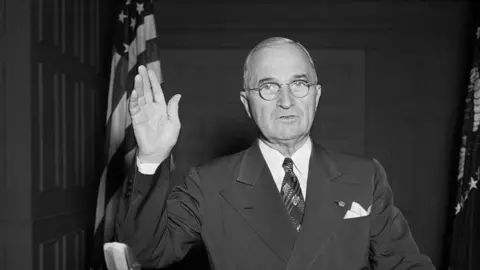
Harry
Truman left the White House without any income other than his Army
pension of $113 (£85) per month. The 33rd US president later wrote that
it was wrong to "commercialize on the prestige and dignity of the office
of the presidency".
George
W Bush put his investments in a blind trust before running for
president, and said in his last week in office that he had no idea how
the 2008 economic crisis affected his net worth.
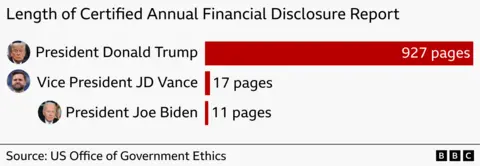
Donald
Trump, in contrast, made at least $2.2bn (£1.7bn) in his first year
back in office, according to a new financial disclosure report - a sum
historians said was unprecedented and shattered the norm of US
presidents avoiding financial conflicts of interest in the White House.
"There's
just no precedent for this," said Barbara Perry, a presidential
historian at the University of Virginia's Miller Center. "It's beyond
anything we've ever seen in the presidency."
Trump's
massive 2025 earnings laid bare just how much he has benefited from his
return to office, through money-making ventures that often blurred the
line between official government policymaking and private business
dealings by the president, his family and close advisers.
Trump
made $1.4bn in the cryptocurrency industry alone, according to the
mandatory financial disclosure that was made public on Tuesday.
Trump
reported $635m in royalties from Celebration Coins, the entity thought
to be behind the $TRUMP meme coin he launched just before starting his
second term.
The
president also reported more than $500m from the cryptocurrency
business World Liberty Financial. The firm was founded by his sons,
Donald Trump Jr and Eric Trump, and the sons of Steve Witkoff, Trump's
special envoy to the Middle East and Ukraine.
Trump's 2025 income was nearly four times higher than the $622m he reported in 2024, the year before he returned to office.
The White House has denied that Trump and his family were profiting from the presidency.
"Neither
the President nor his family has ever engaged - or will ever engage -
in conflicts of interest," White House deputy press secretary Anna Kelly
said in a statement.
She
added: "All actions by President Trump and his administration are taken
in the best interest of the American people – and any so-called
'reporters' pushing otherwise are recycling the same, tired, false
narrative that Democrats and the legacy media have been pushing for a
decade."
Past presidents have been involved in financial scandals that raised questions of corruption.
Historians
point to the period after the Civil War, when officials in the treasury
department under President Ulysses Grant were involved in scandals
around gold sales and customs collection, among other controversies.
The
interior department secretary accepted bribes in exchange for awarding
oil leases during Warren Harding's presidency in the 1920s, an episode
known as the Teapot Dome scandal.
But in those cases, the president was not directly involved or accused of personally enriching himself while in office.
Getty Images
President Truman refused lucrative corporate roles
In
the modern era starting with Franklin D Roosevelt's presidency in 1933,
several presidents have had relatives who sought to profit from their
ties to White House.
Jimmy Carter's brother promoted a beer brand.
While Joe Biden served as vice-president, his son Hunter Biden made money from a Ukrainian energy company.
But
historians said those past examples pale in comparison to the profits
made by Trump and his family business since he returned to office.
"This is the big distinction between Trump and his family and other presidents," said Perry, the presidential historian.
"Making money hand over fist in office, it's not illegal but it is unethical. Most [past] presidents didn't want to do that."
AFP via Getty Images
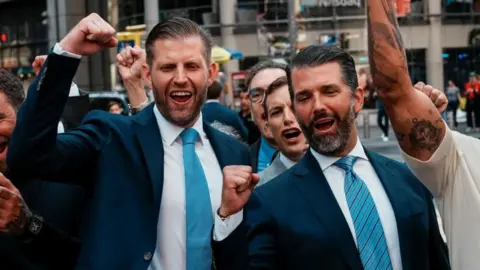
Donald Trump Jr (right) and Eric Trump at the New York stock market last year
Before
starting his first term in 2017, Trump handed control of his family
business, the Trump Organization, to his adult sons. But the move broke
with the precedent set by past presidents because Trump did not place
his business interests in a traditional blind trust or divest from his
real estate holdings and other investments.
Trump took similar steps ahead of his second term.
The
Trump Organization said before his second inauguration that he would
not be involved in the company's day-to-day dealings while serving as
president.
Eric
Trump said at the time that the Trump Organization would follow "robust
ethical standards" during the president's second term.
Pardon for a crypto tycoon
Still,
Trump has made a number of moves in the White House that have benefited
his business as well as businesses tied to other senior administration
officials.
Last
July, Trump signed legislation supporting stablecoins, a form of
cryptocurrency, just four months after World Liberty Financial launched
its own digital currency venture. The firm made Trump at least $500m in
2025, according to his financial disclosure report.
Last October, Trump pardoned Changpeng Zhao, the billionaire founder of the cryptocurrency firm Binance.
The
move came as Trump praised the crypto industry in his first months back
in office, after having dismissed it in the past as a "disaster waiting
to happen".
Trump's
family business and some close associates have profited in other
industries beyond cryptocurrency since he returned to the White House.
Last
year Trump struck a deal with the president of Kazakhstan giving an
American company access to a major critical minerals project in the
country, according to a New York Times report.
Eric
Trump and Donald Trump Jr later took a minority stake in a company
involved in the mining project. The investment firm Cantor Fitzgerald -
which is run by Commerce Secretary Howard Lutnick's sons - also worked
on the deal.
On
Wednesday, Trump attributed his profits in office to stock market gains
and claimed he was not involved in his family's business dealings.
"I
don't get involved in my personal [finances], we have funds that run my
money," Trump told reporters. "I've made a lot of money before I became
president, and they invest my money, and I don't talk to them."
Ethics watchdogs argued Trump's profits from cryptocurrency in particular were problematic.
"Of
course it's a conflict of interest," Richard Painter, the former chief
White House ethics lawyer under George W Bush, told the BBC.
"This is a very, very troubling situation for the American people to see their president making so much money."
Follow
the twists and turns of Trump's second term with North America
correspondent Anthony Zurcher's weekly US Politics Unspun newsletter.
Readers in the UK can sign up here. Those outside the UK can sign up here.