Friday, June 5, 2026

BREAKING : πŸ‡ΊπŸ‡Έ California’s first-ever anti-data center ballot measure is shaping up to be an absolute shellacking for the tech industry — part of a wave of opposition rising across the country, as communities and lawmakers grapple with the frenzied push to build AI infrastructure.
Monterey Park, a city of 60,000 people about 10 miles east of downtown Los Angeles, placed a measure on Tuesday’s ballot asking voters if they wanted to prohibit data centers in their city. The response, so far, has been an unequivocal “yes,” with 86 percent of votes counted as of Wednesday afternoon in favor of the proposal.
Local officials and environmental organizers said they hope the drubbing will spur other cities to enact similar bans.
“A lot of the other cities that are facing data center proposals are going to follow suit,” Elizabeth Yang, the city’s mayor, said on Tuesday. “There’s [a] bad reputation across the board, across the country, from other data centers that have been built in neighborhoods.”
California is one of many states experiencing an explosion of developer interest in constructing new data centers, which house the physical infrastructure that make up the backbone of the internet.
Tech companies racing to develop artificial intelligence models need the computing power stored in these facilities. But the seemingly endless rows of servers and other equipment that fill their floors use immense amounts of electricity and water, which has made them controversial, and sparked backlash and protests.
The Monterey Park vote represents an extension of that resistance in California, and serves as a successful test of a new model for anti-data center activists.
The text of the city’s measure stated that its aim was to “protect air quality, drinking water resources and public health” and prevent increases to residents’ electricity and water rates, and it came about in response to community uproar over a now-abandoned proposal to build a data center in the city.
Monterey Park is believed to be only the second city in the nation to pass an anti-data center referendum, following an April vote in a small Milwaukee suburb (the Data Center Coalition, an industry association, is not aware of any other measures, it told POLITICO). The upswell in opposition has been all the more notable coming in Silicon Valley’s own state, which is an important market for data centers.
“The data center industry will continue to work with California residents, communities, and policymakers to support the responsible development of this critical infrastructure and ensure California remains competitive in the modern economy,” Khara Boender, director of state policy for the Data Center Coalition, said in a statement ahead of the vote.
The result in Monterey Park was a rare piece of bright news for environmental advocates in the state, who suffered a series of setbacks during Tuesday’s primary.
Green groups’ gubernatorial favorite, billionaire climate activist Tom Steyer, trailed both establishment Democratic pick Xavier Becerra and Republican Steve Hilton in initial results. And a slew of progressive down ballot candidates appeared poised to lose to opponents supported by the fossil fuel industry.
Other organizers across the nation have signaled an eagerness to embrace plans similar to the one in Monterey Park, which aim to counter the breakneck race to build infrastructure to support the artificial intelligence boom. That includes a campaign to put a ban on the ballot statewide in Ohio, and local efforts in Georgia, Maryland and Utah.
“What we’re seeing in Monterey Park can be an early step in this being replicated in other parts of the country,” Andrea Vega, a Southern California organizer with environmental group Food & Water Watch, said in an interview.
But Boender warned that there’s a downside to barring data centers from a community.
The Monterey Park ballot measure would “send a signal that the area is closed for business, both for data centers and for other significant economic development projects,” depriving the region of “jobs and investment,” Boender said ahead of the vote.
But voters split with tech interests during Tuesday’s primary, handing the industry a series of electoral losses.
Meanwhile, other states are grappling with how to respond to the massive AI infrastructure buildout in their own rural communities and cities. On Tuesday, the New York Legislature appeared poised to move forward with a one-year moratorium on new large-scale data centers.
Local activists began pushing for a data center ban in Monterey Park after plans by Australian developer DigiCo Infrastructure REIT surfaced to build one in the city. Opponents voiced concerns about how much electricity and water data centers require, and the potential for diesel backup generators to cause air pollution.
“We don’t want any of them to be built in our area,” Amy J. Wong, a volunteer organizer with the group San Gabriel Valley Progressive Action, said in an interview.
The organizers pressured the city council to implement a data center moratorium and place the referendum on Tuesday’s ballot. Following the city council action, the developer, which did not respond to a request for comment, withdrew its proposal.
Data center opponents in Los Angeles County have scored a series of wins in other small cities around Monterey Park, with city councils enacting their own data center moratoriums in recent months. The nearby City of Industry could be next, according to Wong.
That coming fight is the reason why the Monterey Park vote was significant, she said. “It can send a strong message to neighboring cities and other cities in California, and also across the nation.”
California Gov. Gavin Newsom’s office did not immediately respond to a request for comment on the Monterey Park vote.
See less


Thursday, June 4, 2026

This story will make your blood boil. And it happened right here in America just weeks ago.
Residents in Fayette County, Georgia, were told by their local government to stop watering their lawns. Water pressure in their homes was dropping. People couldn’t shower properly. Something was draining the town dry.
So they started investigating. And what they found will shock you.
A massive data center campus located about 20 miles south of Atlanta had been secretly drawing approximately 29 million gallons of water through two water connections that the county didn’t even know existed — and this went on for 15 months before anyone caught it. 
15 MONTHS. Hidden pipes. Millions of gallons. While regular families were being told to stop watering their grass.
Now here’s the part that will really get you angry —
Officials refused to fine the builders of the massive 6.2 million-square-foot facility over the unauthorized water use. The county’s soft response was attributed to the data center being described as “our largest customer, and we have to be partners.” 
So let’s get this straight. A tech company secretly taps into your water supply without permission, drains 29 million gallons while your water pressure tanks, and the punishment is… nothing. Because they’re a “partner.”
πŸ’§ This Is Not an Isolated Incident
This is happening all across America right now.
Data centers powering AI systems consumed approximately 17 billion gallons of water in 2023, and that number is projected to explode to 68 billion gallons by 2028 — a 300% increase in just five years. 
On average, a single medium-sized data center consumes roughly 110 million gallons of water per year — enough to cover the annual water use of about 1,000 households. 
And they’re building thousands of these things. Everywhere.
Many AI data centers are deliberately built in the country’s driest regions to take advantage of cheap solar power — placing enormous strain on water supplies in areas least equipped to handle the extra demand. 
πŸ”₯ Every Time You Use ChatGPT, This Happens
Training a single large AI model like GPT-4 consumed approximately 700,000 liters of water for cooling. And generating just 10–50 AI responses consumes roughly 500 milliliters — about one water bottle. 
Scale that to billions of daily users across every AI platform in the world, and you start to understand just how massive this crisis really is.
😑 Who Pays the Price?
Not the billionaires building these facilities.
Water costs are expected to rise dramatically across affected regions in 2026 as AI consumption spikes. Businesses and consumers nationwide should expect to pay significantly more for water as data centers compete for the same limited resources. 
Regular Americans — farmers, families, small businesses — are already feeling it. The Georgia story is just one example of what’s quietly happening in communities nationwide while the tech giants write the checks and the politicians look the other way.
Georgia families were told to stop watering their lawns. A $10 billion data center was secretly draining their water. And nobody got fined.
This is the AI boom nobody is talking about. Share this before it gets buried. πŸ‘‡πŸ’§ drop a follow for more data center newsπŸ‘Œ
πŸ“Œ Source: Tom’s Hardware — “AI data center project secretly sucked 29 million gallons of water over 15 months before detected by residents” (May 10, 2026)


Saturday, May 30, 2026


I sent this to Gillibrand, Schumer & Riley, as well, and anyone who wants to share it? We are also SNAIL MAILING it.
(IN)Justice John Roberts
"Dear Justice Roberts,
"It has come to my attention through your various media appearances that your feelings are hurt — that people view you and your Court as political actors, which you insist is not an accurate understanding of what the Court does.
"So let me resolve the confusion: the misunderstanding is yours, not ours.
"People believe your Court is political because it is and acts so in plain view of the nation.
"You unleash unlimited corporate money into elections by inventing constitutional protections for concentrated wealth. You dismantle voting protections while dining with the very political movement that benefits from their destruction. You expand presidential immunity in ways conveniently favorable to a corrupt executive you have rewarded with extraordinary deference, 90% deference. And then you perform public astonishment when Americans recognize your pattern.
"Your Court did not merely 'interpret' the Constitution. It selectively hollowed it out whenever democratic participation threatened entrenched power.
"Citizens United accelerated America’s transformation into an oligarchy where billionaires and corporations wield more political influence than millions of citizens combined. Shelby County gutted the Voting Rights Act, after which states moved with remarkable speed to burden the very voters the Act was designed to protect. The immunity ruling signaled that sufficient power can place a president beyond meaningful accountability.
"Then you publicly mourn the collapse of trust. What exactly did you think would happen?
"Legitimacy is not something a court grants itself while issuing ideologically convenient outcomes wrapped in constitutional language — when the public is fortunate enough to even receive a full opinion instead of another consequential ruling buried in the shadow docket.
"Legitimacy is earned through restraint, consistency, ethical seriousness, and fidelity to principle even when principle is inconvenient to power.
"This is precisely the credibility your Court squandered. We understand perfectly well what we have been watching. We all see you and your court and its role in what our nation has become.
"And we are furious — not because we are too ignorant to understand constitutional law, but because we are capable of reading the Constitution you claim to defend- while watching this Court repeatedly twist it to serve its own ideological will.
"History will remember this era. And it will remember you and your Court- not as a guardian of constitutional democracy, but as a key institution that eroded it. That is already your legacy, so stop whining- you earned a nation's scorn."
Elizabeth Layton

Thursday, May 28, 2026


Are you missing the trees for the forest?
Peter Thiel co-founded Palantir in 2003 with a stated mission to make Western liberal democracy legible to itself through data, a formulation that contained within it the entire logic of what followed: the conversion of surveillance capacity into governance capacity, and the positioning of private actors as the architects of that conversion.
 
Larry Ellison built Oracle into the world's second-largest software company and then, through the acquisition of Cerner in 2022, into the custodian of the largest integrated healthcare records database in the United States, a position he has leveraged into federal contracts that place Oracle's infrastructure at the center of the government's health, financial, and administrative data architecture.
 
Mark Zuckerberg built the world's largest behavioral surveillance system under the name of a social network, producing a real-time map of human associational relationships, political expressions, and behavioral patterns that government agencies access through legal process, data broker intermediaries, and the structural fact that Meta's platforms are where organizing happens.
 
Elon Musk acquired the platform through which political resistance most visibly organizes, eliminated the content moderation architecture that previously created friction between speech and surveillance, and simultaneously obtained operational access to federal administrative data systems through his role in the executive branch's efficiency initiative.
 
Alex Karp, Palantir's CEO, built the connective tissue: the data integration and analysis platform that takes what Oracle stores, what Meta produces, what X amplifies, and what federal agencies collect, and routes it through a unified analytical architecture whose outputs power immigration enforcement, law enforcement intelligence, child welfare risk scoring, healthcare surveillance, and financial crime investigation simultaneously.
 
These actors compete with each other. They sue each other, outbid each other for government contracts, and position themselves publicly as operating toward different ends. Those conflicts are genuine at the level of short-term and mid-term corporate interest. They are irrelevant at the level of structural consequence.
 
What these five actors share is not a coordination agreement. What they share is a common political project whose success depends on the same conditions: the elimination of meaningful regulatory constraint on algorithmic governance, the federalization of AI infrastructure as a national security interest that places it beyond ordinary democratic accountability, the consolidation of data control under private corporate architectures that governments can access but cannot govern, and the suppression of the organized community resistance that would otherwise impose accountability on that consolidation.
These conditions do not require their cooperation. They require only that none of them act to undermine them, and none of them has.
 
The absence of a single unified corporate entity is not a gap in this architecture. It is a design feature. A merged mega-corporation would create a single point of accountability, a single target for regulatory action, a single actor whose exposure would compromise the entire system. The distributed architecture is more resilient precisely because it is distributed. When Palantir's ICE contracts produce public outrage, Oracle's healthcare data infrastructure continues operating. When Meta faces congressional scrutiny over its surveillance practices, Palantir's law enforcement contracts expand. When Musk's government access generates political opposition, Thiel's political investments work to ensure that the officials responsible for oversight remain structurally aligned with the infrastructure's expansion.
 
The distribution of the system across competing corporate entities, each with its own political relationships, its own public narrative, and its own apparent independence from the others, is what makes the system difficult to name, difficult to challenge, and nearly impossible to dismantle through the accountability mechanisms that democratic governance provides.
See less


 The Same Families Who Tried to Overthrow FDR Are Running The Government Right Now

A documented trail of money, think tanks, and personnel from the 1933 Business Plot to Project 2025.

 In 1933, a circle of Wall Street financiers allegedly hatched a plan to overthrow Franklin Roosevelt. They didn’t want to kill him. They wanted to keep him in his chair, smiling for photographs, while a puppet official — controlled by the men who paid for the operation — ran the country.

This was the during height of the Great Depression. For the average American, life was one in four men out of work, and the other three terrified they were next. Families lived in shacks made of scrap wood and tar paper. Children went to school hungry. Men walked miles every day looking for work that didn’t exist.


Much like today — the wealthiest 1% owned more than the bottom 40% combined — and these men had the nerve to call Roosevelts ideas dangerous.

Americans were suffering, and close to revolting, and FDR knew it. So, he started to put laws into place to help the average American instead of the ultra-wealthy. And the billionaires were pissed. So they started to scheme. The scheme (known as the Business Plot) failed. The scheme collapsed when the general they recruited refused to play along and reported it to Congress. No one was prosecuted. The ambition, however, never died. 

 That plan took nearly a century to complete. You may know it was “Mandate for Leadership” or “Project 2025.” 

The same families whose fortunes bankrolled opposition to the New Deal — the capitalists who bankrolled an attempted government coup in the 1930s — have funded a network of think tanks, legal societies, and personnel databases that accomplish something the original capitalists could only dream of.

So, to give you some context.

In America, anyone that didn’t live in an industrialists or wall-street financiers family was in a crisis. They were starving to death. So, FDR enacted what was known as the New Deal. This was not one single law, but a collection of programs built around three goals: Relief, Recovery, and Reform. Relief meant getting immediate help to the suffering. Recovery meant restarting the economy. Reform meant changing the rules so it could never get this bad again. 

The Civilian Conservation Corps put hundreds of thousands of young men to work. The Tennessee Valley Authority brought electricity to seven states. The FDIC insured ordinary people’s bank deposits for the first time, so their money was protected. The SEC put the government in charge of watching the stock market. The WPA gave 8.5 million people jobs, and they built roads, bridges, schools, and parks with their own hands. 

And for the worker everything changed. For the first time, the government drew a line in the dirt and said: you cannot be worked to death for nothing.

The new deal gave workers the right to unionize, the 8-hour workday, a minimum wage., the abolition of child labor, and a Social Security check waiting for you if you lived long enough to stop working.

That is why America didn’t revolt. Not because people stopped being angry but because for the first time in a generation, it appeared that the government was visibly, concretely, undeniably on their side. 

This was a direct assault on the idea that the government owed the rich everything and the poor nothing. It helped by putting millions back to work, stabilizing banks, feeding the hungry, and for the first time in a generation, making ordinary people feel like this country actually belonged to them.

The Plot and the People Behind It

The Business Plot, as it came to be known, was not hatched by fringe actors. The men named in congressional testimony (Grayson M.-P. Murphy (a Morgan banker), IrΓ©nΓ©e du Pont, John W. Davis (J.P. Morgan’s chief counsel), and former Democratic National Committee chairman John Jacob Raskob were among the most powerful financiers in America.

They hated Roosevelt’s New Deal.

When their coup failed, they got up, and decided to try again. In 1934, the same cast founded the American Liberty League, the “respectable” face of elite opposition to the New Deal. The du Pont family provided roughly 30% of its funding.

The League distributed over five million publications, built 345 college chapters, and mounted constitutional challenges to New Deal legislation. They argued that programs like the Wagner Act (that gives Americans the right to unionize) violated property rights and exceeded federal power.

The arguments were sophisticated, but the goal was unchanged… they needed to protect their concentrated wealth from democratic interference. Roosevelt won in a 1936 landslide. The League dissolved, but the donor network didn’t.

Following the Money

What followed was not coincidence but continuity that is documented in foundation tax filings, archival papers, and three generations of overlapping board memberships.

The Foundation for Economic Education, America’s first modern free-market “think tank,” launched in 1946 with trustees and board members drawn from the executive ranks of General Motors, Chrysler, and DuPont.

The American Enterprise Institute, founded as the League was collapsing, carried the same agenda in a more ‘academic’ wrapper. The AEI still exists today — where members lobby for pharmaceutical companies who later “donated” them hundreds of thousands of dollars among other ultra-wealthy corporations.

Interesting Fact: Dr. Sally Satel, the AEI scholar exposed by ProPublica for publishing articles that downplayed OxyContin's role in the opioid crisis while citing research paid for by that company, was later sponsored by Vice President JD Vance's nonprofit, Our Ohio Renewal, which paid for her year-long residency in Appalachian Ohio.

Then came the John Birch Society. Founded in 1958, its charter members included Fred Koch — father of Charles and David — and Harry Bradley, whose foundation would become one of conservatism’s largest funders. Pierre S. du Pont III provided a direct family link across organizations. 

Fred Koch had built refineries for both Stalin and Hitler before becoming a fierce anti-communist; his son Charles held a lifetime JBS membership until 1968.

The Mellon-Scaife line is the most traceable of them all.

Andrew Mellon (Treasury Secretary under three presidents and a Liberty League donor) passed his fortune and his politics down through his family.

His grand-niece’s son, Richard Mellon Scaife, contributed approximately $900,000 to the Heritage Foundation in its founding year.

By 1998, his foundations had given Heritage more than $23 million. His total documented giving to conservative causes exceeded $340 million. Koch, Bradley, and Olin foundations added tens of millions more to Heritage and to the Federalist Society, the organization that moved originalism constitutional theory from the ‘legal fringe” group to the Supreme Court majority.

Fred Koch had built refineries for both Stalin and Hitler before becoming a fierce anti-communist; his son Charles held a lifetime JBS membership until 1968.

The Mellon-Scaife line is the most traceable of them all.

Andrew Mellon (Treasury Secretary under three presidents and a Liberty League donor) passed his fortune and his politics down through his family.

His grand-niece’s son, Richard Mellon Scaife, contributed approximately $900,000 to the Heritage Foundation in its founding year.

By 1998, his foundations had given Heritage more than $23 million. His total documented giving to conservative causes exceeded $340 million. Koch, Bradley, and Olin foundations added tens of millions more to Heritage and to the Federalist Society, the organization that moved originalist constitutional theory from the ‘legal fringe” group to the Supreme Court majority.

  • The Liberty League declared its mission to “defend and uphold the Constitution” and “foster the right to work, earn, save, and acquire property.”

  • The Federalist Society’s stated objectives are “checking federal power, protecting individual liberty and interpreting the Constitution according to its original meaning.”

The same argument. The same families. The same money.


The Vessel

The Business Plot’s fatal flaw was its crudeness. They wanted to take control pay paying 500,000 starving veterans to march on Washington.

What the donor network eventually understood (thanks to Lewis Powell’s 1971 memorandum to the U.S. Chamber of Commerce) was that you don’t need an army. You need a system.

The Heritage Foundation's Mandate for Leadership is a conservative “governing manual” that tells an incoming president exactly what to do and how to do it. It started in 1979 and Reagan was the first president to run with it. He handed copies to his whole cabinet on day one and stacked his administration with the people who wrote it.

Tax cuts, deregulation, shrinking federal agencies it all came from that book. Reagan later called Heritage a "vital force" in his presidency.

The Mandate For Leadership document is a 900-page, department-by-department manual for dismantling the federal administrative state, written by over 350 former officials, ready for a president’s signature on Day One.

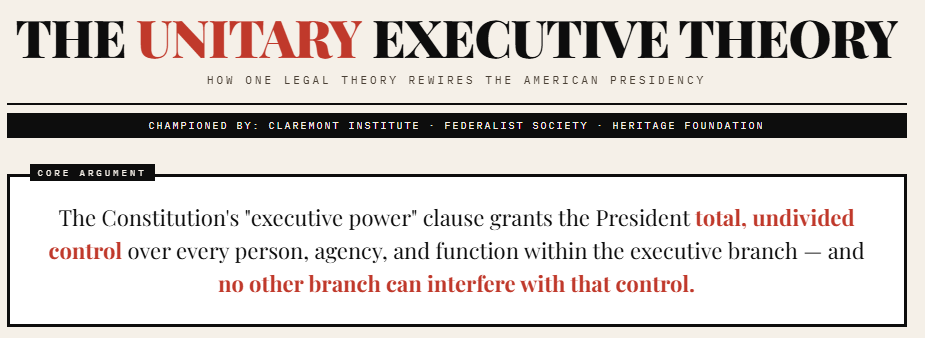
The America First Policy Institute has prepared hundreds of additional executive orders. The Claremont Institute provides the legal structure through the Unitary Executive Theory, which argues a president should have total control over the federal workforce and government. No more checks and balances. 


The final part is personnel.

Heritage has spent tens of millions building a database of thousands of pre-vetted political loyalists ready to fill the roughly 4,000+ open-positions — many of which the administration has already opened up with DOGE in 2025. The way they do this is through Schedule F. Which is a policy to reclassify 50,000 career civil servants as at-will employees, removable by any president who gives an inconvenient order.

Schedule F is something we first saw during the first Trump administration, and he brought it back with an executive order on day one of the second.

The structure is complete: think tanks write the policy, the personnel database installs the staff, and Federalist Society-vetted judges uphold the result in court. The president provides the electoral mandate and the signature. He doesn’t need to know how the Department of the Interior works.


Wednesday, May 27, 2026

 
A new WIRED investigation exposes how federal agencies, including the DHS and FBI along with fusion centers nationwide, are now tracking what they call “anti-tech extremists.”
The label is broad enough to potentially include ordinary citizens raising concerns about AI job displacement, data centers consuming massive amounts of power and water, and the rapid expansion of unchecked technology.
More than 1,000 pages of internal documents reviewed by WIRED reveal intelligence reports that link public opposition to AI and data centers with “anti-tech violent extremism.”
Indicators flagged in these reports include attending town hall meetings, taking photos near construction sites, participating in local budget discussions, and sharing information online about rising electricity costs or environmental strain.
This monitoring comes as residents in at least 42 states push back against data center projects that strain local infrastructure and drive up energy prices.
Most of these groups operate through legal channels and civic participation.
Yet fusion center assessments appear to lump them in with fringe movements, sometimes drawing loose connections to historical extremists.
The scale of this worries civil liberties advocates.
Law enforcement is documenting protected activities such as public dissent, neighborhood organizing, and criticism of major tech companies.
Experts point out this approach mirrors earlier surveillance efforts that later drew criticism for overbreadth and chilling legitimate speech.
To be clear, any actual violence deserves investigation and prosecution.
But treating widespread, reasonable anxiety about job losses, privacy erosion, and the environmental toll of Big Tech infrastructure as a form of extremism represents a significant shift in priorities.
It suggests that questioning elite-driven technological change could now place individuals on the radar of domestic intelligence efforts.
With AI systems spreading quickly and data centers multiplying across communities, the public has every right to debate these changes without fear of being labeled a threat.
Americans should not have to worry that voicing concerns will land them in threat assessments.
This development deserves close attention and greater transparency from those directing these programs.
As I have said , numerous times over the last fourteen years... The increasing militarization of the police is designed to turn the police force into an army of occupation for the totalitarian take down of our country...